
What is nutrient neutrality?
A plain-English explainer for property developers, planning consultants, and self-builders in Norfolk and Kent. What it means, why it’s blocking new homes, and what you can do about it.


The short version
Across England, 27 river catchments — including parts of Norfolk and Kent — are over their pollution limits for nitrogen and phosphorus. These nutrients come from wastewater, agricultural runoff, and other sources. In affected catchments, this triggers planning restrictions on new development.
New homes add a small amount of additional pollution through their wastewater. So before any new residential development can get planning approval in these areas, that additional pollution has to be offset somewhere else.
That offsetting is called “nutrient mitigation.“ Most schemes meet it by buying “nutrient credits“ — units of pollution reduction that cancel out the impact of new homes. Without mitigation, planning permission can’t be granted.

If you’re not sure whether your site falls within a designated catchment, your planning consultant or your local authority’s planning team will confirm. STS’s free eligibility checker can also tell you in seconds.

What you need to do
Your scheme’s nutrient impact is expressed as the additional kilograms per year of total phosphorus (TP) and total nitrogen (TN) it will produce. This figure is what you need to offset.
You have two ways to get it, use a caluclator or get a verified figure from your planning consultant or local authority.
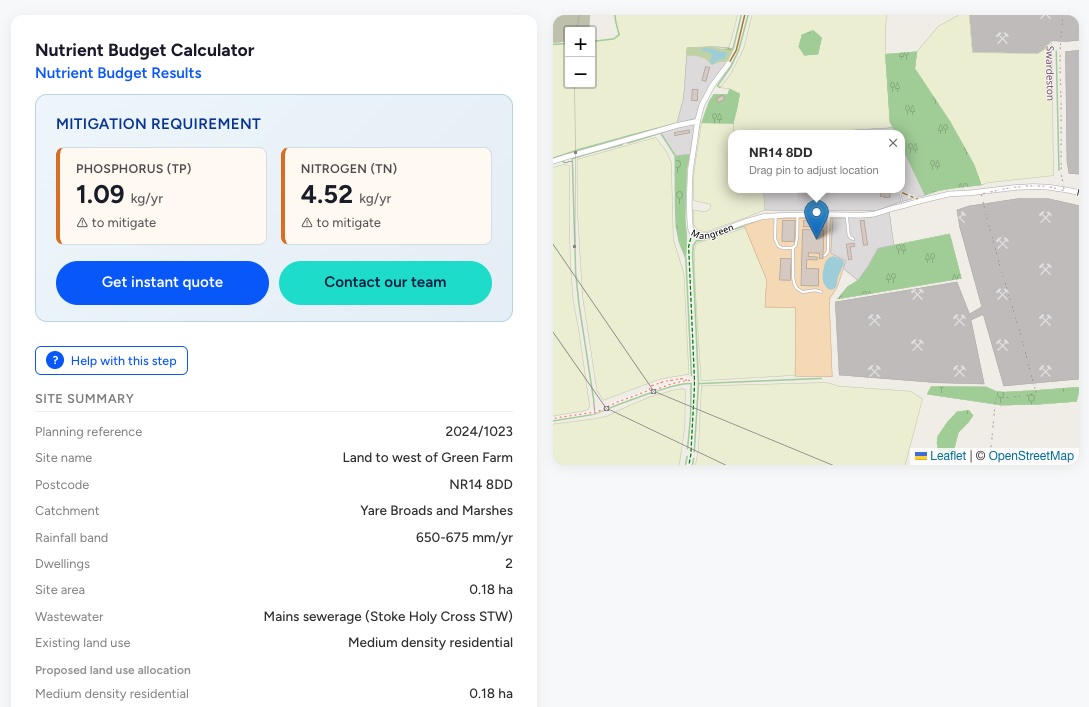
Use a calculator
Indicative TP and TN figures for your scheme in minutes. We’ve built a free nutrient budget calculator specifically for Norfolk and Kent that uses the same methodology your LPA applies — postcode, scheme details, and a few standard inputs, then it gives you the numbers.
Good enough to plan a budget and get accurate pricing for credits.
Get a verified figure from your planning consultant or LPA
For the final figure that goes on your planning application, your planning consultant or LPA case officer will produce a verified nutrient budget using the official methodology. This is typically what’s submitted to the council.
Our calculator’s indicative figure is usually accurate — close enough to plan a project budget around — but the LPA’s verified figure is what gets used in the formal planning application. Once you have your TP and TN figures (indicative or verified), you need to offset them.
You have two routes, buy nutrient credits or implement on-site mitigation.

Buy nutrient credits
The simpler route. You purchase credits from a council-approved provider that match your scheme’s nutrient impact. Credits are typically generated through upgrades to existing wastewater systems, agricultural land changes, or wetland creation.
Most schemes choose this route because it’s faster, the cost is fixed and predictable, and the credits transfer with the planning application.
Implement on-site mitigation
For larger schemes, you can integrate mitigation into the development itself — through alternative wastewater treatment, wetland creation, or other interventions. This takes longer and is more complex, but can make sense at scale.
For most schemes — and especially smaller developments — credits are the practical choice.
They support rare species and habitats that are already under pressure from existing pollution levels.
How STS helps
STS is a Natural England and council-approved nutrient credit provider serving Norfolk and Kent. We generate nutrient credits by upgrading the wastewater systems of homes with older septic tanks — replacing them with modern Package Treatment Plants that produce significantly cleaner effluent than the systems they replace.
The reduction in pollution from each upgrade is verified, registered, and monitored for 90 years. Credits are issued against verified reductions and made available to developers needing mitigation for new schemes.
We’re accepted by every relevant local planning authority across our catchments. Our credits are typically 20% cheaper than other providers in the same catchments, and most credits are available for immediate purchase through our developer portal — meaning your planning application can move forward in days, not months.








Ready to move forward?
Where you are in the process determines the right next step. If you already have your TP and TN figures and want to know what credits will cost. Enter your figures, see the price immediately, get the full quote emailed to you. No sign-up required.
Still need to work out what your scheme needs?
Use our handy nutrient budget calculator — which will give you all the data you need to populate the council spreadsheet for submission.
If you’d rather talk it through with someone
Our team can walk you through the rules, eligibility, and options for your specific scheme. We’ll come back within one working day.
FAQs
Costs depend on your scheme’s nutrient budget and the catchment you’re in. As a guide, STS credits start at around £5,450 per 0.1kg of phosphorus mitigation for Norfolk catchments. The total cost depends on how much TP and TN your scheme needs to offset — most residential schemes need somewhere between 0.3kg and 1.5kg of phosphorus mitigation. Use our calculator or quote tool for a specific figure.
With STS, most credit purchases are completed within 5-7 working days from initial enquiry to signed legal agreement — significantly faster than the 4-6 weeks typical of other providers.
Yes. Nutrient neutrality rules apply to schemes of all sizes, including single dwellings. STS credits can be purchased for schemes from one home upwards.
We currently only serve catchments in Norfolk and Kent. If you’re in a different nutrient neutrality area (the Solent, the Tees, parts of the West Country), your local authority can point you to authorised providers in your region.
The government has indicated that Environmental Delivery Plans (EDPs) under the Levelling-up and Regeneration Act 2023 may eventually offer alternative pathways for nutrient mitigation, but these are unlikely to be operational before 2027/8. Until then, the credits route is the established and operational mechanism in Norfolk and Kent.
Older septic tanks discharge effluent with significantly higher nutrient concentrations than modern Package Treatment Plants. Replacing an older system with a modern one reduces local pollution by a measurable amount — that measurable reduction is what gets registered as a nutrient credit and made available for development mitigation.
Need help?
If you have any further questions or need professional assistance, don't hesitate to contact us.