
News & Insights · Water Innovation
From sewage farms to smart homes
Britain built the world's first large-scale water reuse — then spent a century forgetting it. The history isn't nostalgia; it is a specification for the technology that finally makes home water reuse work, and three products now meet it.
Britain has been recycling water for more than 160 years. It surprises people when you say it, because we talk about water reuse as if it were a Californian import or a Singaporean novelty. It isn't. We did it first, at scale, in the 1860s — and then we quietly gave up on it. And why we gave up on it is the most useful thing you can know about the water technology turning up in homes today. The history isn't a curiosity. It's a checklist.
Swipe to see the full timeline →
We have done this before
In Victorian Britain, reuse wasn't an environmental gesture. It was the treatment process. After the Great Stink of 1858, Bazalgette's sewers moved London's sewage downstream but didn't clean it, so the engineering answer became the sewage farm: effluent piped onto farmland, purified by soil and microbes while it irrigated and fertilised crops. Beddington in Croydon began doing exactly this in 1860 — on the same ground where the BedZED eco-village would be built 142 years later. Cambridge pumped its sewage uphill to a farm at Milton. Reuse and treatment were the same act.
It ended for one reason, and the reason matters. Beddington's own sewage farm was giving way to a conventional treatment works by around 1912; two years later, at Davyhulme in Manchester, Ardern and Lockett perfected the activated sludge process, which let you treat the same load of sewage on a fraction of the land. Once treated effluent could safely go to the river, the farms — expensive, land-hungry, increasingly overloaded — were surplus. Reuse didn't fail on public health, and it didn't fail on water quality. It failed on economics. A cheaper way to get rid of the problem came along, and reuse dropped out of the design vocabulary for the better part of a century.
Hold onto that, because it is the pattern that repeats.
Drought brings it back — and the demonstrators that taught us
What revived reuse was scarcity — and scarcity is arriving more often, not less. The 1975–76 “standpipe drought” — the driest five-year run since 1850 — gave us the Drought Act, street standpipes and “Save Water, Bath with a Friend.” For a while the serious droughts looked a generation apart: 1995–96, then 2022. That spacing no longer holds. We are in another drought now, in 2026, barely four years on. What used to be a once-in-a-generation emergency is becoming a recurring condition — and each drought has pushed reuse a step further, with the industry building something to prove what it could do.
The demonstrators are worth reading as a set, because each one paid for a lesson.
The Millennium Dome's “Watercycle” (2000) was the largest in-building recycling scheme in Europe at the time — up to 500,000 litres a day, blending rainwater, handbasin greywater and groundwater through ultrafiltration and reverse osmosis to meet 55% of the Dome's water demand for six million visitors. It worked, and the public accepted it.
BedZED (2002), the UK's first large eco-village, built a reedbed “Living Machine” to treat its own wastewater on site. It didn't work. The reedbed couldn't clean the water well enough, the sums didn't add up, and it was quietly abandoned. On-site biological treatment doesn't scale down gracefully.
Langford in Essex (2002) is the quiet success nobody talks about: around 30 million litres a day of recycled effluent topping up the River Chelmer, still running, adding roughly 8% to Essex's water availability. It survives for a dull reason. A water company owns it, funds it, and has written it into a statutory resource plan.
And Old Ford, in the Olympic Park (2012), was the UK's largest blackwater recycling scheme — treating sewage to non-potable standard and piping it round the Park for toilet flushing and irrigation, cutting tap-water use there by nearly 60%. It was decommissioned in 2019. Not because the technology failed — it worked fine — but because there was never enough guaranteed demand from the surrounding buildings to keep it viable.
Swipe to see the full table →
| Scheme | Year | What it did | Outcome | The lesson |
|---|---|---|---|---|
| Millennium Dome | 2000 | 500 m³/day; met 55% of demand | Worked, publicly accepted | Technology and acceptance were never the problem |
| BedZED | 2002 | Reedbed “Living Machine”, 100 homes | Abandoned | On-site biology does not scale down |
| Langford, Essex | 2002 | 30 Ml/day into the River Chelmer | Still running | Utility-owned, funded and obliged — so it lasts |
| Old Ford | 2012 | 574 m³/day, purple-pipe network | Decommissioned 2019 | Died from lack of demand, not performance |
Read those four together and the pattern is hard to miss. The one that survived is the one with an owner, a funder and an obligation. The ones that died, died from demand-side economics and an absent duty holder — not from anything wrong with the treatment. Beddington in 1912, BedZED in 2002, Old Ford in 2019: the same failure mode across two centuries.
The history is a specification
So the history hands you a specification — not a wish list, a specification. If schemes die from cost, maintenance and missing demand rather than from dirty water, then the technology worth backing is the technology that designs those failure modes out. It should be compact, not land-hungry. It should have no consumable filters and no chemical dosing — the running costs and service visits that quietly kill domestic systems. It should watch itself. It should last. And ideally it should have somewhere to put the water it saves on the day it's switched on. None of that is glamorous. It is exactly what keeps a system running once the novelty wears off.
There is a British twist that sharpens the point. Under the Water Supply (Water Fittings) Regulations 1999, recycled water is Fluid Category 5 — the same hazard class as sewage — so any mains top-up needs an air gap and bespoke backflow protection. That is why UK domestic reuse kit is bulkier and dearer than its continental cousins, and it is exactly why a compact, certified, self-contained unit is worth more here than almost anywhere else.
With that specification in hand, three technologies stand out — each attacking a different point in the home water cycle: reuse the water, never lose it, and stop what leaks away invisibly.
Three technologies that meet it
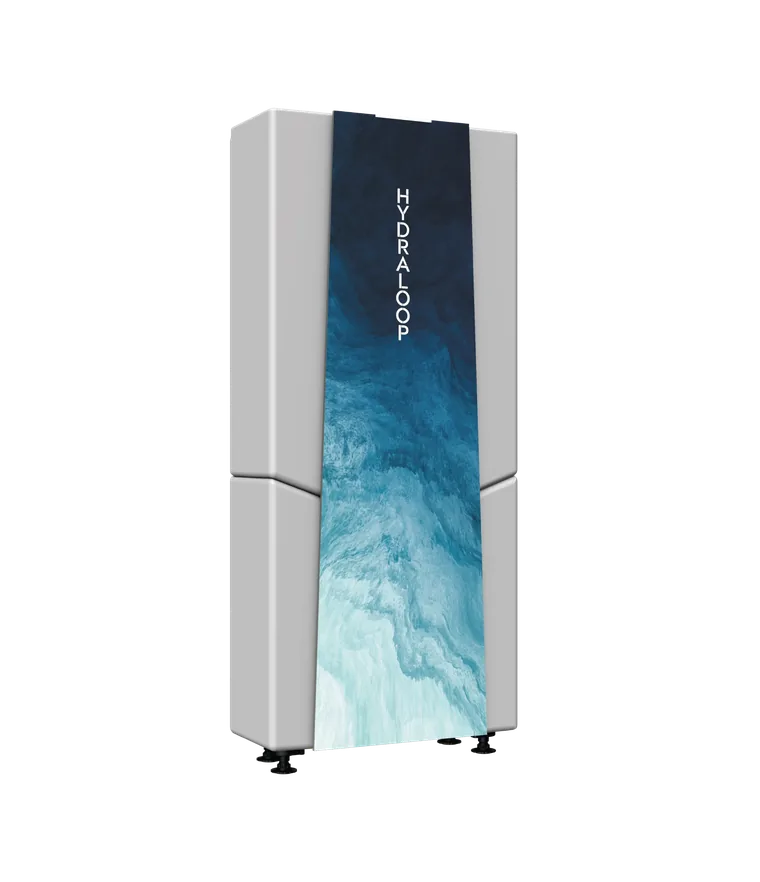
Hydraloop — reuse the water. A fridge-sized cabinet that treats the greywater from showers, baths and washing machines so it can be reused for flushing, laundry and the garden. What makes it interesting against our specification is what it doesn't have: no replaceable filters and no chemicals. It cleans water through six physical and biological stages and finishes with UV — recycling up to 95% of the greywater passing through it and cutting a household's fresh-water demand by up to 45%. It's certified to NSF/ANSI 350R and won CES's Best of Innovation in 2020. In other words, it's built to dodge exactly the maintenance tail that killed everything before it.
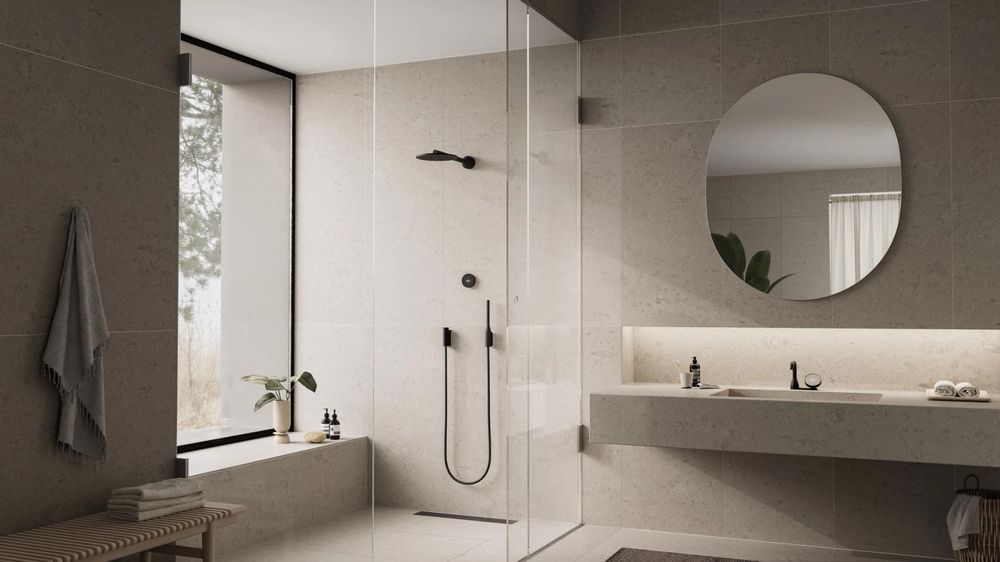
Orbital Systems — never lose it. A Swedish shower system, developed from NASA water-reuse research for a Mars mission, that purifies your shower water in real time and pumps it straight back to the showerhead. It senses water quality twenty times a second, diverting dirty water to the drain and recirculating the clean — so you shower on roughly 20 litres for as long as you like, against about 100 for a conventional ten-minute shower. Up to 90% less water and, because the water stays hot, up to 80% less energy. It is a genuinely closed loop rather than a store-and-treat batch — the same instinct as Langford's engineered reliability, shrunk to a single bathroom.
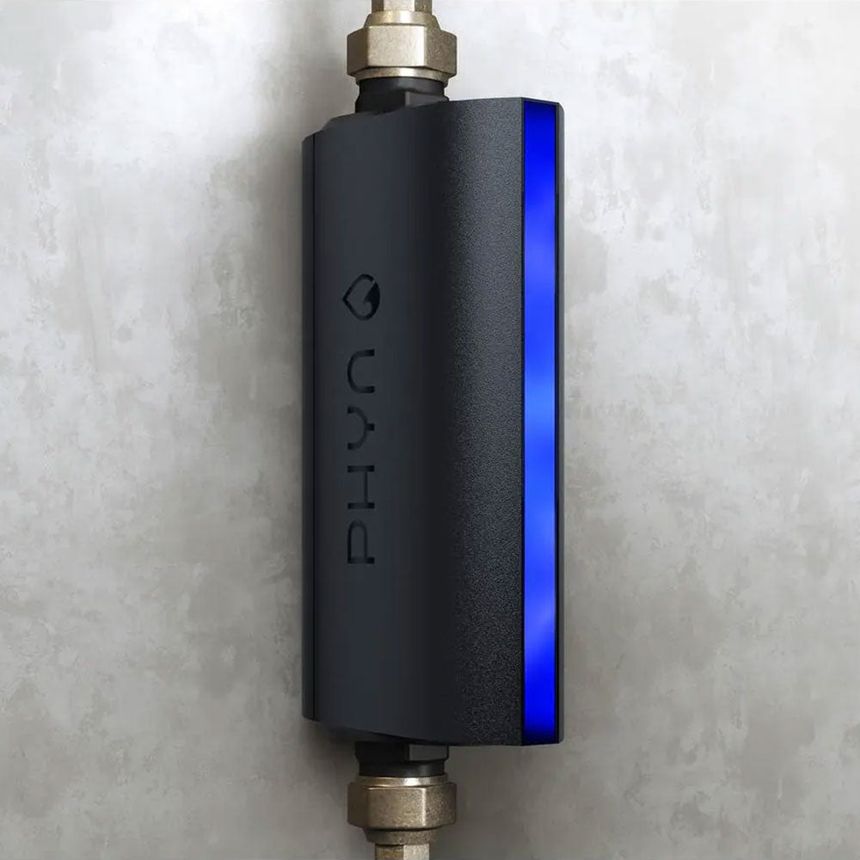
Phyn Plus — stop what leaks. The other two save the water you use; this one saves the water you lose without noticing. A single device on the mains samples water pressure 240 times a second and uses machine learning to learn the signature of every fixture in the house, so it can spot a pinhole leak or a slow drip that a flow meter would miss — and shut the valve on its own when a pipe bursts. Household leaks are one of the largest invisible losses in domestic water, and at around $580 with no subscription it's the cheapest of the three by an order of magnitude. It's self-monitoring by design, which is rather the point.
Swipe to see the full table →
| Technology | Attacks | Headline | Consumables | Self-monitoring |
|---|---|---|---|---|
| Hydraloop | Reuse the greywater | up to 95% recycled; −45% mains | None — no filters, no chemicals | Yes |
| Orbital | Recirculate the shower | −90% water, −80% energy | Filter ~every 200 showers | Yes, via app |
| Phyn Plus | Stop the leaks | drip-level detection; auto shut-off | None | Yes |
Why this matters here
There is a particular reason to pay attention to all of this from where we sit. The East of England is the driest region in the country and one of the fastest-growing — hundreds of thousands more people are expected over the next two decades, and the homes to house them have to be built somewhere. Anglian Water, the supplier for most of the region, forecasts a shortfall of around 570 million litres a day by 2050 without action — roughly half the water it puts into supply today. Widen the lens to the whole of the East and Water Resources East, the regional planning body Anglian Water helped set up, puts the gap closer to 800 million litres a day. Either way, the number is enormous.
New reservoirs are on the way — the Fens and South Lincolnshire schemes, together meant to serve at least 750,000 homes. But they will not deliver a drop until the mid-to-late 2030s at the earliest, and even then they are only part of the answer. A gap that size does not close by building supply alone. It closes at both ends of the pipe: by supplying more, and by needing less.
None of the home technology is a silver bullet, and it is worth being straight about the limits. At today's prices water is cheap enough that a greywater system saves perhaps £100–£200 a year — small savings, precisely because the water is cheap — so no single household should expect one to pay for itself quickly. And reuse is not automatically greener: pumping and treating a litre of greywater can take more energy than supplying a litre of mains water, so any serious system has to earn its place on whole-life carbon, not just on litres saved.
But a region facing an 800-million-litre gap can't keep designing reuse out of its new homes the way the country has for a century. The history is clear about what actually lasts, and it isn't the cleverest scheme. It's the one with the lowest running cost, the least to maintain, and a real use for the water. A century and a half of British water reuse has already written the specification. The interesting thing about Hydraloop, Orbital and Phyn is that — unlike the Living Machine at BedZED, or the working plant they switched off at Old Ford — they were built to meet it.
The cheapest litre of water is still the one you never had to supply twice. In the driest, fastest-growing part of the country, that is not a slogan. It is arithmetic.
Sources: UK water-recycling history (Beddington from 1860; Davyhulme activated sludge, 1914) — Beddington Farmlands; Mara, Historical aspects of wastewater treatment. Demonstrators — IWA (Millennium Dome), Bioregional (BedZED), Water Projects Online (Langford), Queen Elizabeth Olympic Park and EWSC (Old Ford). Fluid Category 5 — Water Supply (Water Fittings) Regulations 1999. Cost and carbon — Ricardo for Waterwise (2020); Environment Agency (2010). Regional shortfall — Anglian Water WRMP24 (~570–593 Ml/d) and Water Resources East (~800 Ml/d); reservoirs — Anglian Water. Technologies — hydraloop.com, orbital-systems.com, phyn.com.